
thoughts butWhen you sit cross-legged on a yoga mat, close your eyes, and try to calm your chaotic thoughts through deep breaths, the most frustrating moment is often not the wandering of thoughts, but the blockage in your body—you find yourself having to forcefully twitch your nostrils to inhale enough air.
In the world of yoga practitioners and meditation enthusiasts, we’re used to buying expensive yoga mats, cork blocks, and meditation cushions, often neglecting the most crucial energy channel: our nasal cavity. For those seeking ultimate mind-body connection, nasal strips are quietly moving from the bedroom bedside table to the yoga studio’s storage bag.
Today, we will explore from the perspective of biomechanics and energy flow why this little sticker might become your most unexpected pranayama tool.
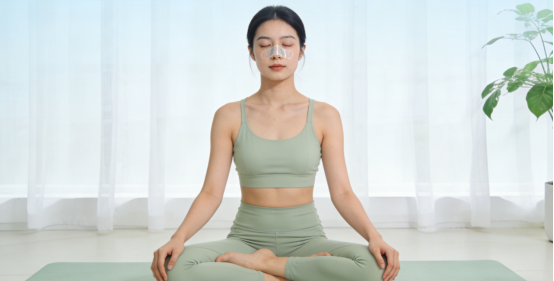
The mechanical paradox of breathing: Why does the nose become more blocked the more you inhale?
When practicing Ujjayi (throat breathing/victory breathing) or preparing for deep meditation, the teacher always guides us to breathe “deep, slow, and evenly.” However, many people feel their nostrils collapsing inward when trying to inhale deeply, causing the airflow to be interrupted.
Disturbance of Bernoulli effect
This isn’t because you haven’t practiced enough; it’s due to the laws of physics.
According to Bernoulli’s principle, the faster a fluid moves, the lower its pressure. When you try to take a strong, deep breath, the airflow in your nasal cavity increases, causing a drop in internal air pressure.
If your nasal valves are soft or naturally narrow, the external atmospheric pressure will push your nostrils inward, causing physical blockage.
This is the core value of nasal strips for yoga. Like an external skeletal support, it uses its resilience to forcefully open the nostrils. It counteracts the negative pressure generated during inhalation, ensuring that the airway remains fully open during intense Vinyasa or static pranayama practices.
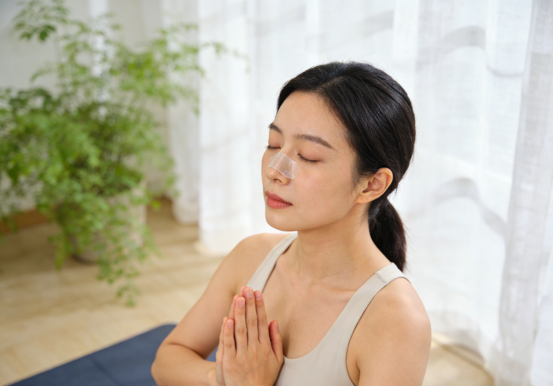
Optimize Nadi Shodhana: Physical aid for balancing the left and right meridians
In yoga philosophy, Nadi Shodhana (alternating nostril breathing) is a key practice for balancing the body’s Yin and Yang energies (Ida and Pingala). However, in reality, due to the physiological “nasal cycle,” one nostril is usually relatively congested and blocked.
Breaking through physiological limitations
Practicing alternating breathing can be very painful when one nostril is blocked. You may feel anxious due to lack of oxygen, which defeats the purpose of the practice. Using nasal strips as a meditation breathing aid can artificially correct this asymmetry.
Through physical expansion, it can restore more than 30% of the airflow to the nostril that was previously congested.
When you no longer need to distort your facial muscles or force yourself to breathe, your attention can truly shift from the “struggle to breathe” to the “awareness of breathing.”
This smoothness can help you enter an Alpha brainwave state more quickly and achieve true deep tranquility.
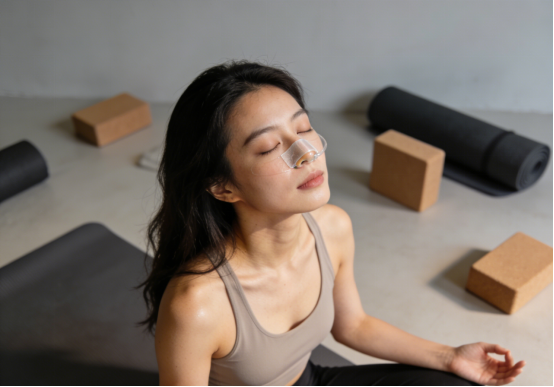
From “Fight” to “Surrender”: A Switch in the Nervous System
The core of meditation is to allow the parasympathetic nervous system (responsible for relaxation and repair) to take over the body. However, obstructed breathing can trigger a stress response in the body.
Say goodbye to “breathing anxiety.”
If breathing is obstructed, the brain subconsciously sends out a “suffocation alarm,” activating the sympathetic nervous system (fight or flight mode). This is the physiological reason why many beginners feel restless and fidgety during meditation.
Using the strategy of “better breathing for mindfulness”—that is, applying nasal strips—can eliminate this subconscious survival panic.
When air slides into the bottom of the lungs without resistance, the diaphragm can descend fully, the vagus nerve is stimulated, and the body can truly allow itself to “relax.”
In this sense, nasal strips are not just physical expanders; they are a calming switch for the nervous system.
Invisible energy pillar
In yoga practice, we use yoga blocks to aid in body alignment and stretch muscles to lengthen their lines. Similarly, we should embrace nasal strips as a yoga breathing aid to optimize our energy (prana) intake.
Don’t think it’s strange to wear a nose strip in the meditation room. When you can dive deeper into that tranquility than others and ride the waves of your breath more freely, this little sticker is an invisible key to your inner temple.
True freedom begins with the freedom to breathe.
FAQ
“Sport”
1. Will the Nasal Strips I wear during Hot Yoga fall off because of sweat?This is a common challenge. Regular nasal stripscan indeed lose their adhesiveness in high-temperature environments.It’s recommended to choose products labeled “Extra Strength” or “Sport,” and thoroughly clean the area around your nose of any oiliness with an alcohol swab before applying.Additionally, apply them at least 30 minutes before you start sweating to allow the adhesive to fully bond with your skin.
nasal strips
2. Will the nose strip affect the sensation when doing inverted or downward-facing dog poses?Not at all;in fact, it helps. In an inverted position, the nasal mucosa is prone to congestion and swelling (because blood flows back to the head). Wearing Nasal Strips can effectively combat this positional nasal congestion, allowing you to maintain a clear head sensation and smooth breathing while inverted.
3. Will relying on nasal strips for yoga for a long time cause me to be unable to breathe without them?
No. Nasal strips are a physical aid, like yoga blocks. They help you build proper “deep breathing muscle memory” during practice.As your diaphragm strengthens and your breath control improves, you’ll be better able to guide airflow even after removing the strips. It’s a teaching tool, not a permanent crutch.