
As a parent, every time your child has a stuffy nose or takes a rapid breath, it tugs at your heartstrings. Medication might cause side effects, while traditional humidifiers and nasal sprays don’t seem direct enough. You may have seen nasal strips at the pharmacy; they seem like a simple, drug-free solution, but an important question arises: Are nasal strips really safe for children? Can my child use these strips??
This is a complex issue because children’s noses are not miniature adult noses. Their bone structure, skin sensitivity, and airway obstruction patterns are all different. Safety and comfort must be the top priorities when choosing any breathing aid for a child.
This guide aims to provide clear and practical guidance for parents concerned about their children’s respiratory health. We will delve into how nasal strips work to suit children’s physiology and what key features should not be compromised when choosing a nasal congestion solution for children.
Table of Contents
Step 1: Understanding the Special Characteristics of Nasal Congestion in Children
Nasal congestion often has a greater impact on children’s health than on adults, for the following reasons:
1. Structural: Smaller airways, greater impact
Children’s nasal passages and throat structures are relatively small. Even slight swelling or mucus can lead to a much higher rate of airway obstruction than in adults. This obstruction can cause mouth breathing at night, leading to a range of problems: night cough, dry throat, sleep disturbances, and even affecting maxillofacial development.
2. Physiology: Limitations of drug use
Pediatricians generally recommend limiting the use of decongestants because children may be more sensitive to certain medications, and there is a risk of drug dependence. This makes the need for non-pharmacological interventions for nasal congestion solutions in children even more urgent.
3. Behavior: Difficulty cooperating
Children often find it difficult to cooperate with continuous nasal irrigation or spray treatments. Therefore, any effective nasal strip for children must be disposable, easy to apply, and comfortable.

Step 2: Why Nasal Strips are a Non-Drug Choice
Nasal strips make them a powerful supplement to children’s respiratory health management because they completely bypass the risks associated with medications.
- Non-chemical intervention: Nasal strips gently lift the skin and cartilage on both sides of the nose using built-in elastic bands. This is a purely physical process that does not introduce any chemicals into the body.
- Anti-collapse: For children who are prone to nasal wing collapse during sleep (even without obvious nasal congestion), nasal strips provide external support to ensure that the nose can continuously and effectively inhale air.
- Promoting nasal breathing: Prolonged mouth breathing can affect a child’s facial and teeth development. By making nasal breathing easy and comfortable, children’s nasal strips can help children develop healthy breathing habits.
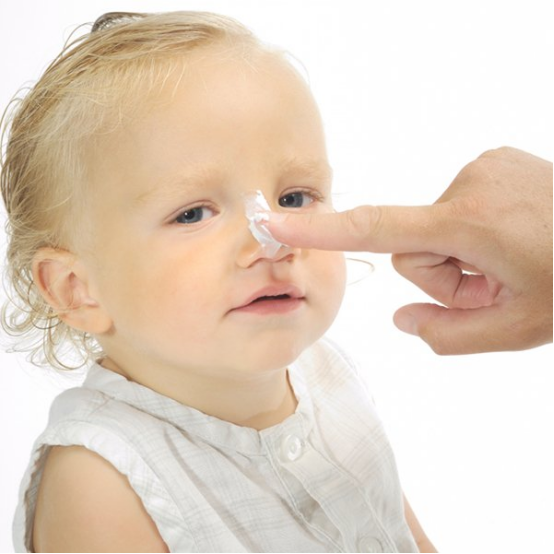
Step 3: Key Considerations for Choosing Nasal Strips for Children
nasal strips as a solution for children’s nasal congestion, parents must abandon adult standards and focus on the following three key factors:
1. Size and fit: Safety is the primary standard.
Adult nasal strips are too large and have too much stretch for children. Forcing adult-sized strips into use may result in:
- Skin irritation: The adhesive covers too large an area and is difficult to remove, increasing the pulling on sensitive skin.
- Poor results: If the center of the patch is not precisely aligned with the nasal flap area, it may compress the nasal ala, which is counterproductive.
Children’s nose strips must be designed specifically for smaller noses, with shorter lengths and gentler elastic bands to provide comfortable yet adequate expansion. Before purchasing, always make sure the product packaging indicates “kid-sized” or the applicable age range (e.g., 5-12 years old).
2. Adhesives: The guardian of sensitive skin
Children’s skin is usually thinner and more sensitive than adults’. Prolonged wear or frequent removal can cause redness, irritation, and even leave marks.
- Hypoallergenic formulation: Look for nasal strips that use hypoallergenic or sensitive skin-specific adhesives. Many high-quality strips use medical-grade silicone or hypoallergenic acrylic adhesives.
- Removal tips: Make sure to guide your child to slowly remove the strips in a warm, moist environment (such as during a bath) to minimize pulling on the skin.
3. Usage Scenarios and Product Types
While most children’s nose strips are designed for nighttime use, you may need to choose different types depending on your child’s needs:
| Requirement Scenarios | Recommended product features | Why? |
| Nighttime sleep | Emphasizing breathability and gentle adhesion | Ensure comfort throughout the night and avoid nighttime dry mouth and mild awakenings. |
| Physical Education/Sports Class | Emphasizing waterproof and sweatproof properties and strong fastening | The strips don’t come off when you sweat during strenuous exercise. |
| Allergy season | Emphasizing thinness and hypoallergenic materials | Reduces skin burden and is suitable for continuous use. |
Make a wise choice
Incorporating nasal strips into your child’s respiratory health management is a wise decision, providing a safe and effective non-pharmacological approach to managing nasal congestion. However, choosing the right size and material is crucial. As a parent, your role is to ensure that the products you purchase are designed specifically for children and provide the most comfortable and safest experience.
Nasal strips are only an adjunct tool for persistent or severe breathing problems. Consulting a pediatrician or ENT specialist is always recommended before introducing any new nasal congestion solutions for children.
Choose the right tools for your children so they can breathe easily and grow up healthy.