
Your lungs are burning, your thigh muscles are oozing lactic acid, and the finish line—or your final lift—still seems so far away. At this critical moment, your body craves only one thing: oxygen. More, faster oxygen. This is precisely why many high-performing athletes are turning to nasal strips as a crucial, non-pharmacological performance aid.
You’ve trained for months for this moment. You’re wearing carbon-plated running shoes, a smartwatch that monitors heart rate variability, and drinking carefully formulated electrolyte solutions. But you might be overlooking a performance bottleneck that’s not only free but also right on your face: your nose.
In the world of competitive sports and high-intensity training, even a 1% advantage can be decisive. When we invest heavily in equipment and supplements, we often forget that aerodynamics applies not only to racing gear but also to the human respiratory system.
Today, we delve into that little gadget worn on the noses of NFL players and endurance runners—these simple strips—to see how, through purely physical mechanisms, they become a secret weapon for breaking through physical limits.
The overlooked “air hunger” and the work of breathing
Imagine you’re trying to drink a thick milkshake through a thin straw. You need to use a lot of force to suck it up, right? That’s the situation your respiratory muscles (diaphragm and intercostal muscles) face when you’re doing high-intensity exercise.
As exercise intensity increases, the body’s demand for oxygen rises exponentially. We instinctively begin to inhale forcefully. However, there is an anatomical paradox here: when you forcefully inhale through your nose, the resulting negative pressure (the Bernoulli effect) actually draws the narrowest part of the nasal cavity—the nasal valve—inward.
This is like when you floor the accelerator, the air intake automatically narrows. The result is a significant increase in what’s called “work of breathing.” Your body has to divert energy that would otherwise be used for your leg or arm muscles just to keep breathing. This is why nasal strips are included in the competition.
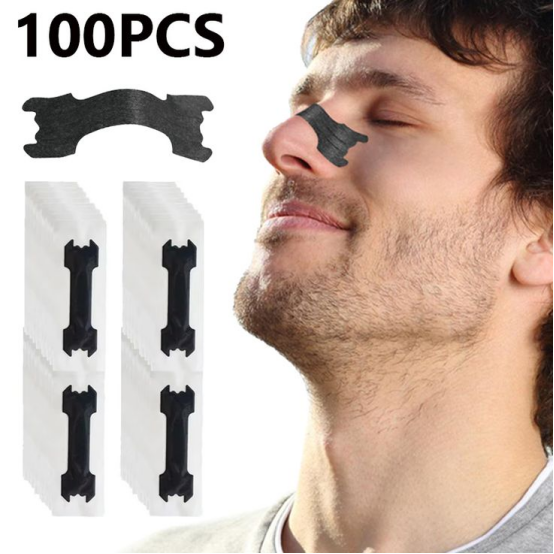
These seemingly simple nasal strips are not placebos. They utilize the rebound force generated by embedded springs to physically resist the collapse of the nasal flap area. This isn’t just about making you feel more comfortable; it’s about fluid dynamics. By preventing the nasal sidewalls from collapsing during intense inhalation, nasal strips reduce airflow resistance. This means that, for the same intensity of exercise, your body expends less metabolic energy on the act of breathing. Every joule of energy saved can be converted into the power for your next sprint.
Nitric oxide: A biochemical advantage brought by nasal breathing
You might ask, “If breathing through the nose is so difficult, why don’t I just breathe through my mouth?” This is indeed the instinctive reaction most people have when they reach the lactate threshold. But this is precisely where the difference between amateurs and top experts lies. Nasal breathing has unparalleled biochemical advantages over mouth breathing, the core of which is a gas: nitric oxide.
Our sinuses are the body’s main factories for producing nitric oxide (NO). This gas is a powerful vasodilator and bronchodilator. When you breathe through your nose, the inhaled air carries this nitric oxide into your lungs. This significantly improves the efficiency of gas exchange in the alveoli, allowing the blood to absorb more oxygen and deliver it more effectively to the working muscles. Maximizing this process is why many athletes rely on nasal strips.
Once you switch to mouth breathing due to excessive nasal resistance, you immediately cut off this natural “oxygen booster.” Using nasal strips physically ensures that this crucial nasal pathway remains open.
In CrossFit races, marathons, or interval training, the real tactical value of wearing nasal strips lies in their ability to delay the point at which you are forced to switch to mouth breathing. By widening the nasal passages, these strips allow you to maintain efficient nasal breathing even in higher heart rate zones. This not only improves athletic performance but also postpones muscle fatigue through more efficient oxygen utilization. It’s truly like installing a more efficient intake manifold in a car, allowing fuel to burn more completely.
Recovery and Rest: Winning Between Sets
Nasal strips are not only useful during exercise; they are equally important during rest periods between sets or during recovery between matches.
Anyone who has done HIIT (High Intensity Interval Training) knows that what determines your performance is often not how fast you can run, but how quickly you can lower your heart rate. Nasal breathing not only delivers oxygen but also activates the parasympathetic nervous system (responsible for relaxation and recovery). Conversely, rapid mouth breathing continuously stimulates the sympathetic nervous system (fight-or-flight response), keeping the body in a state of constant stress.
By using nasal strips to optimize breathing during exercise , you can more quickly regain stable nasal breathing during rest periods after high-intensity workouts. This rapid “reset” of various physiological parameters allows you to have more energy reserves when starting the next set of exercises.
Many weightlifters who wear nasal strips report that they regain their breathing rhythm more quickly between heavy sets of squats or deadlifts. This is not a placebo effect; it’s a more efficient gas exchange mechanism helping the body clear accumulated carbon dioxide.

Sweat and Adhesive: How to Keep It from Falling Off Under Extreme Conditions
As a sports aid, the biggest challenge facing nasal strips is not the principle, but the real environment—sweat.
Nothing is more distracting than having a nose strip slip down to your mouth in the last 100 meters of a sprint. For commercial users, understanding how to wear it correctly to cope with extreme conditions is crucial.
Regular cleaning steps are insufficient for athletes. If you plan to use it in sweaty conditions, a thorough “degreasing” process is essential. Oils and sweat on the skin are a nightmare for the adhesive. Before applying, vigorously wipe the sides of your nose with an alcohol swab until your skin feels completely dry and even slightly tight.
Furthermore, the placement is more sensitive during movement than during sleep. Placing it too low will affect the expansion of the nostrils, while placing it too high will fail to support the nasal flap area. The optimal placement is usually directly above the junction of the hard and soft bone of the nose.
For those who engage in contact sports such as basketball or Jiu-Jitsu, the presence of nasal strips may be slightly less noticeable, but for non-contact sports such as running, cycling, tennis, or gym training, it is a physical enhancement with virtually no side effects.
Rethink your sports gear list
We live in a data-driven era of athletic performance. We analyze cadence, power output, and VO2 max. However, sometimes the solution doesn’t need complex algorithms; it simply requires reverting to basic physiological structures.
Nasal strips offer an extremely cost-effective way to optimize your “breathing system.” They are doping-free, comply with all anti-doping agency regulations, and their workings are transparent. They’re not magic and won’t turn you from a couch potato into an Olympic champion, but for those already pushing their limits, the tiny bit of breathing resistance they eliminate could be the key to breaking personal bests (PBs).
If you’re looking for more tips on how to improve endurance through breathing control during exercise, you can delve into our [High-Efficiency Breathing Training and Heart Rate Control Guide] to learn how to combine hardware (nose strips) with software (breathing techniques).
Next time you tighten your shoelaces, preparing for a tough training session, try sticking a patch on your nose. Feel the smooth airflow going straight to the bottom of your lungs. While your opponent is panting beside you, you’ll find that you still have control over your breathing. That’s the advantage.