
mirror orIf you’ve ever carefully examined your nasal cavity in the mirror, or consulted an ENT doctor about persistent unilateral nasal congestion, you’ve most likely heard the term “deviated septum.”
It’s like a perfectly smooth two-lane highway where the median strip has grown crooked, causing one lane to become extremely narrow.
nasal strips.Many people searching for deviated septum relief without surgery are recommended to try Nasal Strips.
But the question that arises is quite direct: can this little thing, which looks like a band-aid, really “straighten” bent cartilage?
As industry observers, we first need to dispel a highly tempting illusion:
stripsNasal Strips cannot change your anatomy. They are not orthotics, but rather a physiological “expansion solution.”

The rigidity of bones and physical tension
septums,To understand if nasal strips help deviated septum, one must first understand the nature of nasal septum deviation.
The “shaping” of cartilage and bone
The nasal septum is a rigid barrier formed by the perpendicular plate of the ethmoid bone, the vomer, and the septal cartilage.
It remains physically rigid even if this structure is bent due to congenital development or trauma.
nasal stripsThe core structure of Nasal Strips consists of built-in elastic polymer bands (spring-like bands) that generate a tensile force of approximately 20 to 30 grams.
tissue butThis force is sufficient to stretch skin and soft tissue, but absolutely insufficient to shake established bone. Therefore, expecting to achieve a non-surgical nose fix through topical products is biomechanically untenable.
Why is it still “effective”?
Since it cannot correct the bones, why do many people feel an instant improvement in breathing after applying it?
theThis involves the “bottleneck” of nasal airflow— the nasal valve area. This is the narrowest part of the nasal cavity.
When you have a deviated septum, the resistance in the nasal valve area on the narrower side increases exponentially.
The role of nasal strips is to stretch the nasal sidewalls outward, artificially expanding the cross-sectional area at this bottleneck. Although the median strip in the middle of the road is still crooked, it expands the roadside guardrail outward by 3 millimeters, allowing airflow to naturally enter.
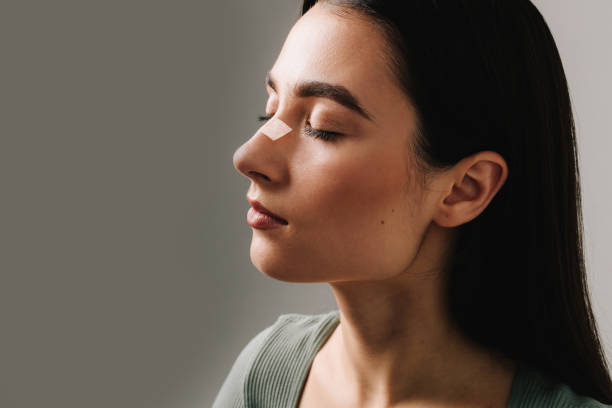
Management of asymmetrical ventilation in patients with deviated nasal septum
blockage butFor patients breathing with a crooked nose, the greatest suffering is often not the complete blockage, but the respiratory compensation and decreased sleep quality caused by the asymmetry.
Mitigating the collapse caused by the Bernoulli effect
In severe cases of deviated septum, airflow accelerates as it passes through the narrower side. According to Bernoulli’s principle in physics, the faster the flow, the lower the pressure.
This means that when you inhale forcefully, the narrower side of the nostril is more likely to collapse inward, making breathing even more difficult.
Nasal strips act as an “exoskeleton” here. They reinforce the nostrils with physical tension, preventing them from collapsing dynamically during inhalation.
While this method of septal deviation relief doesn’t cure the underlying condition, it significantly reduces the work of breathing, freeing you from excessive chest muscle exertion to inhale that last breath of oxygen.
Preoperative and postoperative auxiliary positioning
nasal stripsIn clinical pathways, Nasal Strips are often regarded as an important “litmus test”:
Conservative treatment period: For patients with mild deviation who do not wish to undergo septoplasty, it is the safest long-term management tool.
nasal stripsPostoperative recovery period: The nasal mucosa will experience a long period of swelling after surgery. During this time, doctors may recommend using Nasal Strips to physically help open up the space and reduce the patient’s feeling of shortness of breath.
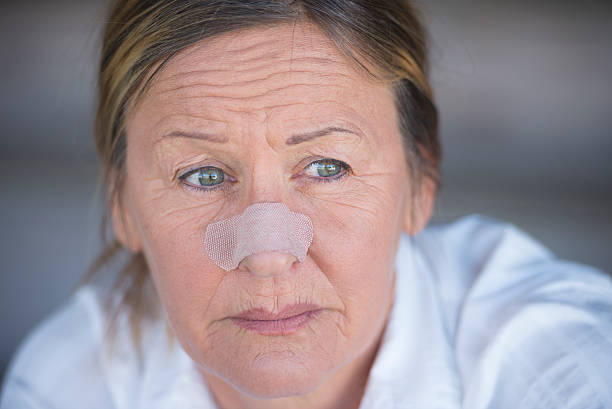
Who should not rely solely on nose strips?
theirWhile we acknowledge the remarkable effectiveness of nasal strips in managing symptoms, as practitioners of the EEAT principle, we must point out its limitations and avoid over-marketing.
nasal stripsBony atresia: If your nasal septum is so deviated that it is completely pressing against the side wall, the space for physical expansion is extremely limited, and the effect of Nasal Strips will be greatly reduced.
Accompanying sinusitis: Nasal strips can only solve the immediate problem. If the deeper sinus openings are blocked due to deviation, leading to chronic sinusitis, you will still need medical intervention.
removal.”Looking for a permanent solution: Remember, this is an auxiliary method that is “effective immediately and invalidated upon removal”.
A cost-effective coexistence strategy
a deviatedNasal strips are not the cure for deviated septum; they are a lubricant for coexisting peacefully with this anatomical defect. While they cannot give you a straight septum, they can buy you that precious 30% space each night for your deprived right to breathe.
For most people experiencing breathing with a crooked nose, trying this non-invasive, low-cost, and side-effect-free septal deviation relief solution is undoubtedly the most logical first step before considering surgery.
FAQ
nasal strips1. Will wearing Nasal Strips for a long time make the deviation worse?
tissue andNo. As mentioned earlier, the pulling force of a nose strip acts on the skin and superficial soft tissue, and cannot generate structural stress on the deeper bones and cartilage. It neither corrects nor worsens the deviation.
nasal strips2. How can I determine if Nasal Strips will help with my skewness?
You can do a simple “Cottle Test” self-test: Gently pull the skin on both sides of your nose with your fingertips, diagonally upwards towards your ears. If you feel a significant improvement in breathing during this movement, then nasal strips will be very helpful for your deviated septum relief without surgery, as they simulate this stretching motion.
3. If I plan to have septoplasty, will using it before the surgery have any impact?
Nasal strips before surgery. If you find that physically opening the nasal flap area provides a satisfactory quality of life, you may be able to postpone or reassess the necessity of surgery. However, please be sure to follow your doctor’s advice for specific preoperative instructions.