
Table of Contents
Many people are confused when trying nasal strips: why don’t they seem to improve their breathing after applying them? This “ineffective experience” isn’t entirely determined by the product itself but involves several usage details, nasal cavity type, and individual differences. Understanding these key factors can help users better optimize results and reduce unnecessary disappointment.
Application location: Not even a millimeter can be ignored.
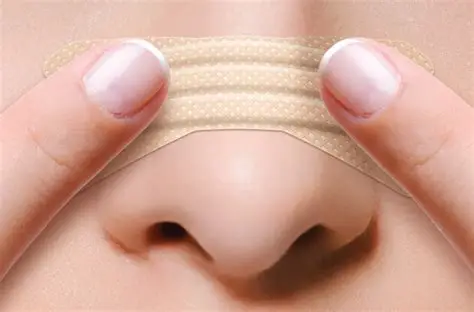
Many users are unaware that even slight deviations in the placement of nasal strips can have a significant impact on the results. The cartilage on both sides of the bridge of the nose and the nostrils are key areas where airflow is obstructed. If the strips are placed too high or too low, the air passages may not be fully opened.
Industry experience shows that applying nasal strips close to the most prominent part of the outer side of the nose, ensuring the strips are flexible and cross the junction of the bridge and nostrils, is key to improving airflow. If the user applies them too close to the tip or top of the nose, air will still be obstructed in the narrow nasal passages, creating the feeling that “nasal strips are not working.”
In addition, gently wiping the bridge and sides of the nose before applying the patch to ensure the skin is clean and free of oil can significantly improve the adhesion and elasticity. Subtle differences in details often determine the difference between nighttime sleep and daytime breathing experiences.
The subtle relationship between skin condition and fit
Skin moisture, sebum secretion, and even minor flaking can affect the adhesion of nasal strips. For people who sweat easily or have oily skin, even if the strips are applied correctly, they may slip or fall off, preventing air from effectively expanding the nasal cavity.
Some users find that their nasal strips are partially loose when they wake up in the morning, which is one of the common “nasal strip mistakes.” The solution is not complicated: before use, gently pat the bridge of your nose to make the skin slightly dry, and avoid applying the strip immediately after applying skincare products to reduce oil interference. This not only improves the fit but also makes the airflow improvement more noticeable, fully demonstrating the value of airflow improvement tips.
Nasal cavity type and individual differences
Not all noses are exactly alike: wide noses, narrow noses, lateral structures, and slight septal deviations can all affect the actual effectiveness of nasal strips. For narrow or deviated nasal cavities, the support provided by the strips may be limited to some passages, while others remain obstructed.
Studies show that users who rely solely on a single trial to judge a product’s effectiveness are likely to conclude it’s “ineffective.” In reality, adjusting the fit angle multiple times, trying different strip lengths, or combining this with a slightly elevated head sleeping position can significantly improve overall airflow. Understanding one’s own nasal cavity characteristics is a key aspect of improving user satisfaction.
Sleep posture and breathing coordination
Sleeping position at night also has a significant impact on the effectiveness of nasal strips. When lying on your back, the base of the tongue and soft palate may collapse slightly, increasing upper airway resistance; lying on your side is more conducive to natural airflow, but pressure on one nostril may still affect airflow.
In practical use, nasal strips can be maximized by combining them with a suitable sleeping position. For example, slightly elevating the head at night and avoiding a pillow that is too soft and causes pressure on the nostrils can allow the nasal strips to better guide airflow. This kind of synergy in details is often a key factor that many users overlook.
Common Mistakes and Optimization Strategies
- Inaccurate placement: Slight deviations can result in no noticeable improvement in airflow. The solution is to use the widest part of the nostrils as a reference, spanning the junction of the bridge and nostrils.
- Oily or damp skin: The adhesive may not stick properly, and the strip may loosen. Cleanse skin before use and avoid applying skincare products immediately.
- Ignoring differences in nasal cavity structure: a narrow or deviated nasal cavity may have limited effectiveness. Try different combinations of angles and lengths multiple times.
- Sleeping posture affects airflow: lying on your back may increase upper airway resistance, while sleeping on your side can improve unilateral airway compression. Combining sleeping posture adjustments will have a more significant effect.
- Over-reliance on a single experience: The effect may not be significant on the first use. It is recommended to observe for several consecutive nights and combine this with fine-tuning and optimization.
Nasal strips, more scientifically, reduce the probability of an “ineffective experience” and improve overall breathing comfort.
Advanced usage tips and extensions
Besides basic fit and position optimization, there are some advanced methods to improve the results:
- Airflow test: Use touch or a slight exhale test to determine if the nasal strip effectively opens the nostrils.
- Combine with breathing exercises: When using nasal strips at night, you can combine them with light breathing exercises to enhance awareness of airflow.
- Observe the nighttime state: Pay attention to whether there is a decrease in snoring or a reduction in the number of times you wake up at night. This is a more quantifiable effect than simply feeling that the air is flowing smoothly.
in conclusion,
When you feel that nasal strips are not working, the problem is often not with the product itself, but rather a combination of factors including usage details, skin condition, nasal cavity structure, and sleeping posture. By ensuring precise fit, controlling skin condition, understanding your own nasal cavity characteristics, and adjusting your sleeping posture, the vast majority of users can experience significant improvements in breathing.
In summary, common reasons why nasal strips don’t work can be categorized into three main types: fit, skin, and nasal structure. Correcting nasal strip mistakes directly impacts airflow improvement and nighttime breathing quality. Mastering these airflow improvement tips allows users to experience product effects more rationally and reduces the risk of churn due to misjudgments.
A scientific understanding of how to use it and the importance of paying attention to details is the key to enabling nasal strips to truly deliver value in optimizing nighttime breathing.