
Table of Contents
In daily nasal care, many people face a common dilemma: should they rely on nasal strips for non-pharmacological ventilation or use nasal sprays to relieve nasal congestion? Both methods have their advantages and disadvantages, but understanding their usage boundaries and applicable scenarios can help users establish a more rational decision-making framework, making respiratory management safer and more efficient.
Understanding the mechanistic differences between the two approaches
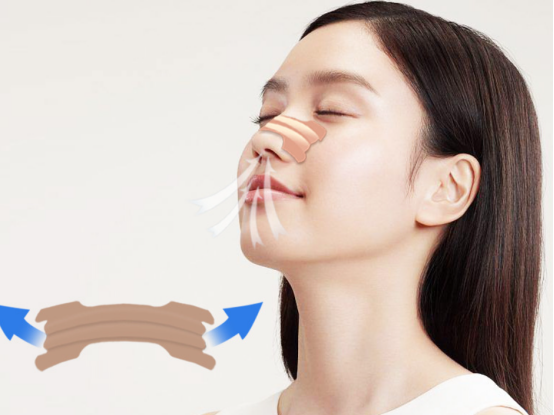
Nasal strips work by physically widening the nostrils and bridge of the nose, increasing the width of the nasal passages and thus improving airflow. This method provides completely drug-free congestion relief, without relying on chemical ingredients, and will not cause drug dependence or long-term side effects. Users can experience natural and smooth breathing during sleep at night or during light daytime exercise or work.
In contrast, nasal sprays typically contain active ingredients that constrict blood vessels or lubricate the nasal mucosa. They act quickly and are suitable for short-term nasal congestion or allergic rhinitis attacks. However, frequent use may lead to nasal dryness, dependence, or rebound congestion. Understanding this difference in mechanisms helps in making more informed choices among nasal care options.
Usage Scenarios and Applicability Analysis
In daily life, users’ needs for nasal ventilation often fall into several scenarios:
- Mild nasal congestion or daily breathing difficulties, such as dry office air, mild allergies, or difficulty breathing before exercise.
Nasal strips: Provide a continuous, gentle nasal wing opening effect without the need for medication, suitable for daily use.
Nasal sprays: Use may be slightly excessive in such mild cases, and frequent use carries a higher risk.
- Acute nasal congestion or allergic rhinitis attack: such as significant nasal congestion at the onset of a cold, affecting sleep at night.
Nasal strips: can still help improve air circulation but may not provide complete relief when used alone.
Nasal spray: Provides significant short-term and rapid relief from nasal congestion, suitable for acute situations.
- Nighttime snoring or sleep apnea: Some users want to improve their sleep quality.
Nasal strips: Improve breathing through physical ventilation, especially suitable for mild obstructive conditions.
Nasal sprays: can be used as a temporary aid, but long-term reliance is not recommended.
opposites butThis comparison shows that nasal strips and nasal sprays are not simply opposites, but rather options to “replace or supplement” based on needs. For mild, long-term, or daytime respiratory optimization, nasal strips offer a safe, non-pharmacological solution, while nasal sprays are suitable for short-term emergency care or intervention for specific conditions.

Risk Boundaries and Safe Use Recommendations
While nasal strips are generally safe, there are still some precautions to take. First, improper placement of the nasal strip may result in poor effectiveness or even minor skin irritation. Second, for patients with severe nasal structural abnormalities (such as deviated septum) or chronic severe nasal congestion, nasal strips alone may not be sufficient to meet their ventilation needs. In such cases, combining them with professional treatment or short-term nasal sprays may be more effective.
For nasal sprays, the risk boundaries are more clearly defined:
- Continuous use beyond the recommended number of days may easily lead to dry mucous membranes, dependence, or rebound nasal congestion.
- ,When used in combination with other medications , be aware of potential ingredient conflicts to avoid local irritation or systemic side effects.
- Patients with chronic diseases should consult a professional doctor before use to prevent potential risks.
.In practice, users can follow the principle of “prioritizing light use and supplementing for urgent needs,” using nasal strips as a basic long-term strategy and nasal sprays for short-term, acute interventions, thus forming a scientific and rational framework of nasal care options .
Combinatorial thinking in daily practice
A well-chosen combination of strategies can improve breathing comfort without increasing risk. For example:
- :Nighttime sleep : Those with mild obstruction can use nasal strips alone to significantly improve breathing ease and sleep quality.
- , applyDuring the day, while working or doing light exercise : Apply nasal strips to maintain continuous airflow and reduce decreased concentration or exercise fatigue caused by nasal congestion.
- ,,In the early stages of a cold or with acute nasal congestion : use nasal sprays for a short period to relieve symptoms, and apply nasal strips to help maintain physical ventilation, avoiding complete reliance on medication.
The core of this strategy is to clearly define the boundaries of each tool’s function and the duration of its use, allowing users to maximize breathing ease and comfort without increasing their medication burden.
User experience and scientific basis
Multiple user feedback reports indicate that long-term use of nasal strips alone can improve daily breathing comfort, especially during mild nasal congestion, exercise, or focused activities. Clinical studies also indicate that physical ventilation intervention is a safe, non-pharmacological, drug-free congestion relief option suitable for long-term and daytime use.
Research suggests that nasal sprays can indeed improve breathing and sleep quality in the short term with their rapid relief, but frequent use can lead to rebound nasal congestion. Therefore, viewing nasal sprays as complementary rather than competitive helps in developing long-term, safe, and effective breathing management habits.
Summary and Decision-Making Approach
, By comparing nasal strips vs nasal spray, several key conclusions can be drawn:
- Their mechanisms of action differ: nasal strips physically open the nostrils, while nasal sprays improve ventilation through chemical action.
- long-term, different application scenarios: nasal strips are more suitable for mild, long-term, or daytime use; sprays are suitable for acute symptom intervention.
- : The risk boundaries are clearly defined: nasal strips are highly safe; for sprays, attention should be paid to the duration of use, ingredients, and potential for dependency.
- Combining approaches can optimize results: physical and chemical strategies can be applied flexibly according to individual symptoms and time constraints.
Understanding this “substitution rather than opposition” framework can help users manage their breathing problems more rationally in their daily lives, thereby improving comfort, reducing the risk of unnecessary medication use, and taking into account both nighttime sleep and daytime activity experiences.